ads link
Showing posts with label Health. Show all posts

Mobile phone brain cancer link rejected

The risk mobiles present has been much debated over the past 20 years as use of the phones has soared.
The latest study led by the Institute of Cancer Epidemiology in Denmark looked at more than 350,000 people with mobile phones over an 18-year period.

Researchers concluded users were at no greater risk than anyone else of developing brain cancer.
The findings, published on the British Medical Journal website, come after a series of studies have come to similar conclusions.

'Reassuring' But there has also been some research casting doubt on mobile phone safety, prompting the World Health Organization to warn that they could still be carcinogenic.
In doing so, the WHO put mobile phones in the same category as coffee, meaning a link could not be ruled out but could not be proved either.
The Department of Health continue to advise that anyone under the age of 16 should use mobile phones only for essential purposes and keep all calls short.


These results are the strongest evidence yet that using a mobile phone does not seem to increase the risk of cancers of the brain or central nervous system in adults”
End Quote Hazel Nunn Cancer Research UK
The Danish study, which built on previous research that has already been published by carrying out a longer follow-up, found there was no significant difference in rates of brain or central nervous system cancers among those who had mobiles and those that did not.
Of the 358,403 mobile phone owners looked at, 356 gliomas (a type of brain cancer) and 846 cancers of the central nervous system were seen - both in line with incidence rates among those who did not own a mobile.

Even among those who had had mobiles the longest - 13 years or more - the risk was no higher, the researchers concluded.

But they still said mobile phone use warranted continued follow up to ensure cancers were not developing over the longer term, and to see what the effect was in children.
Hazel Nunn, head of evidence and health information at Cancer Research UK, said: "These results are the strongest evidence yet that using a mobile phone does not seem to increase the risk of cancers of the brain or central nervous system in adults."

Prof Anders Ahlbom, from Sweden's Karolinska Institute, praised the way the study was conducted, adding the findings were "reassuring".
Prof David Spiegelhalter, an expert specialising in the understanding of risk who is based at the University of Cambridge, said: "The mobile phone records only go up to 1995 and so the comparison is mainly between early and late adopters, but the lack of any effect on brain tumours is still very important evidence."
And Prof Malcolm Sperrin, director of medical physics at Royal Berkshire Hospital, said: "The findings clearly reveal that there is no additional overall risk of developing a cancer in the brain although there does seem to be some minor, and not statistically significant, variations in the type of cancer."

But the researchers themselves do accept there were some limitations to the study, including the exclusion of "corporate subscriptions", thereby excluding people who used their phones for business purposes, who could be among the heaviest users.

Health Insurance

Willing umbrella before it rains. This maxim is precisely applied in our daily lives. We as humans can not know the future. Now we may be healthy, but if the Lord wills, perhaps next week we hit a disease that we do not expect before.


Are you already making preparations to face the possibility of pain in the future? How is your financial plan? Do you realize, that the cost of hospital medicine + doctor + is not cheap? Can you pay all that when the time comes?

This website aims to introduce the concept of health insurance to you. With health insurance, medical expenses will be covered by insurance companies. Please read the following article to add to your understanding:
  1. Why do we need health insurance?
  2. Insurance Calculator
  3. Insurance programs
If you are interested to participate in health insurance and are still confused, you can request a free consultation from us. We will answer your questions and provide relevant information.

Your Path to Successful Control of Diabetes

If you've had diabetes for a year or more, you've probably already learned the skills you need to manage your condition, yet it's natural to feel overwhelmed at times. You can make your management plan easier to live with. Try these tips to help keep yourself on the path to good health.

Evaluate your lifestyle

Write down the things in your life that make it hard to stick with your routine. Then think of ways to improve the situation. Here are some suggestions:
  • Keep stress under control. Stress is a normal part of life. It can be short term, such as having to wait in line when you’re in a hurry, or long term such as living in a difficult marriage. Mental stress causes the body to produce extra hormones. These hormones make it difficult to control your blood sugar. Short-term stress will go away, but long-term stress won’t—and it may make it difficult to manage your diabetes.  You can keep stress under control through exercise, hobbies, community activities, and relaxation techniques such as breathing exercises. 
  • Get moving. Make it easy to get exercise. Exercise will help control your blood sugar, reduce stress, and control weight. Join a gym close to home or keep your walking shoes by the front door for a quick jaunt after dinner. Recruit your spouse or a friend—exercising with a partner can be motivating.
  • Eat well. Good nutrition and a careful meal plan will make it easier to manage your diabetes and control your weight. Buy nutritious foods. Stock your kitchen with fruits, vegetables, and high-fiber foods. You're less likely to succumb to cravings if high-fat treats are out of reach.
  • Stay up to date. Keep up with recommended screening exams and immunizations for you and your family. Although your attention is focused on managing your diabetes, don’t forget to have recommended dental checkups, cholesterol and cancer screenings recommended for your age and gender, and vaccinations, such as an annual flu shot or a one-time pneumonia shot. Your children and spouse should get appropriate screenings and vaccinations, too. Healthy family members will help keep you healthy and reduce stress.
  • Know what to do when you get sick.  Colds, the flu, and intestinal upsets are common, but they can make control of your blood sugar more difficult. Talk with your health care provider and plan how you will take care of yourself if you become ill.

Encourage support

If family or friends seem to be undermining your efforts, sit down and talk seriously with them about how important their support is to you and to your efforts. Let them know what you need to do to control your diabetes and how they can help. Also, take a look at your own behavior. An on-again, off-again approach to diabetes management can confuse people.
If you don't belong to a support group, consider joining one. Also, think about offering support to people who have just been diagnosed. Helping others can help reinforce your efforts. Look for a group through your local clinic or the American Diabetes Association.

Prepare for setbacks

Everyone has setbacks. When you veer off course, try not to beat yourself up; that will only increase your risk for a relapse. Rather, ask yourself what made you start to slip:
  • Are your goals too high? Small, easy-to-attain goals are easier to stick with.
  • Are you having trouble sticking with your plan? Now may be the time to assess how well your management plan matches your lifestyle. Then talk with your doctor about making some changes.
You're more likely to overcome temporary setbacks if you get right back on track. Give yourself credit for all the progress you've made, and focus on what you can learn from the experience.

Reward yourself

Make it part of your diabetes management plan to set reasonable goals, and then treat yourself when you reach one. For example, when you fit in four or more exercise sessions in one week, take your medicine at the right time for a week or have only a small slice of cake on a special occasion, give yourself a nonfood reward. Keep a list of these rewards handy.
Because you have diabetes, you've made many changes that we all should make for good health. Instead of focusing on what you've given up, try to remember what you have to gain from your healthy habits. A positive attitude can help you keep up with those habits for life.

Child dental health care tips

Care and maintenance of oral health should start early, and childhood is the perfect time for it. Parents play an important role here because the parents are directly every day interacting with children and take full responsibility for children's health, especially dental health. Here are tips and things that deserve the attention of parents:


Provide adequate calcium intake for your child's teeth strong. The amount of recommended calcium intake for children aged 4-8 years is as much as 800mg. Milk is a good source of calcium for kids.


Avoid giving drinks sugar in a bottle (milk bottle) to your baby or child. Why? as this can cause damage (caries / hole) tooth, especially dental caries in the front of your child. This type of tooth decay is very rapid development.


Brush your child's teeth, if they have not been able to brush their own teeth. Then teaching them brushing their teeth, until they can do it themselves. Watch the way they brush their teeth, whether it is appropriate or not.

10 signs of pregnancy

Not sure you are pregnant have your period a week too late? Despite pregnancy test pack to test, sometimes believe changes to the body as a sign of pregnancy is still a powerful way.

Here are 10 signs to make sure whether or not you are pregnant? yuk, we check:

1. Nipple / breast softer

If you are pregnant, you will recognize that the breasts and nipples become tender around three weeks after conception (when your period about a week late). Maybe breasts feel swollen, similar to the current period.

2. Appears spots and cramping

When you're pregnant, usually marked by the appearance of pink spots on the underwear that occur during implantation (when the embryo attach to the lining of the uterus. This happens about 8-10 days after ovulation, a bit earlier than the arrival time of menstruation).

We sometimes misconstrued as menstruation, only a shorter time than normal menstruation. Cramps are also common in early pregnancy. Until the second trimester of pregnancy, cramps like this will appear. Contractions of the uterus occur regularly, increasing with exercise, orgasm and even a change of position.

3. Darkening of the areola

In early pregnancy, you may recognize the areola (the dark area surrounding the nipple) begin to become darker and larger in diameter. It is believed that the growing darkness of the color of the areola helps the newborn find the nipple to suckle. You may also be recognized that the vein in the breast become more visible because the tension in the breast.

4. Excessively tired

If you are pregnant, the most common symptom in the first eight to ten weeks is feeling tired. During pregnancy, the body undergoes significant changes in metabolism. All your body needs to make adjustments to new processes fetal growth. for most women, fatigue will go at 12 weeks gestation.

5. Nausea and vomiting

If you are pregnant, early pregnancy, a few days after conception, may be experiencing morning sickness. Morning sickness is actually the wrong name, because in fact, nausea and vomiting can occur at any time: morning, noon, night.

6. Frequent urination

When your period is one to two weeks late, maybe the desire to urinate more often than usual. This is because the growing fetus in the uterus pressing the urinary tract. So was dying for a pee.

7. Constipation


Defecation (BAB) is difficult and not smooth? This commonly occurs in early pregnancy. Growth hormones produced during pregnancy cause the intestines become more flexible and less efficient.

8. Increased basal body temperature

Well, we can be sure you're pregnant if basal body temperature increases, the time period that should come missed. and not down to the level prior to ovulation. Moment of conception, the fertilized ovum in the fallopian tubes, and requires about a week to the uterus, in which the fertilized ovum will stick in there.

9. Menstruation did not come.

This is a sign of early pregnancy, especially if used regular menstruation. Combined with the positive signs in the above, chances are you are pregnant.

10. Pregnancy test.

If you want to verify the truth, do it with a test pack which can be freely bought in pharmacies. Accurate urine test for pregnancy 10-14 days of age. Remember, pregnancy tests that can be done at home was not necessarily 100% correct, even after a blood check though. If all test results are negative, while you feel like a pregnant, do more tests. This time to the gynecologist.

History of Asbestos.

Diagnosis of lung-related illnesses linked to asbestos exposure occurred as early as 50 AD, during the time the Romans used asbestos. In the 1800s, industries in the United States extensively used asbestos in large manufacturing and milling plants. By the 1900, workers in the industries were already showing signs of asbestos-related diseases, including asbestos cancer and mesothelioma.

Our time line provides you with dates and important information to educate yourself on the truth about how long industries have known of the dangers of asbestos.
Time Line of Key Events

1927 – Dr. W.E. Cook – publishes an article in the British Medical Journal that asbestosis is known to cause death

1930 – Merewether & Price – publishes the first clinical study examining hundreds of workers in England's asbestos industry. The study is released with the following findings:

Asbestos can cause death
Asbestos products are hazardous
Education of workers is key


1932 – Memo on Silicosis and Asbestosis - finds that asbestos products are a health hazard

1935 – Lynch & Smith – Asbestos linked to lung cancer in multiple cases reviewed

1949 – Journal of the American Medical Association – Asbestos causes cancer

1950 – Newsweek – Asbestos causes cancer

1955 – Doll Study – Sir William Richard Doll was a renowned British physiologist. He published that asbestos caused cancer, which he indicated was proven beyond a doubt

1960 – Wagner Study – Asbestos exposure causes mesothelioma

1964 – Dr. Irving Selikoff study published in the Annals of the New York Academy of Science – Asbestos products cause cancer

1965 – Selikoff / Hueper Publication – Many occupations are in danger of asbestos cancer

1972 – Occupational Safety and Health Administration (OSHA) – Asbestos regulations passed

1977 – Consumer Product Safety Commission – Bans asbestos joint compound

In spite of OSHA measures to tighten asbestos use and ensure protection of workers, people are still exposed to this dangerous substance today. Legislative measures are being proposed but are still under consideration.

It is important to communicate any known asbestos exposure to your doctor in order to receive appropriate mesothelioma treatment. It is also important to remember that your exposure could have been prevented. If you find you have mesothelioma, or another asbestos disease, you should consider contacting both a physician well-versed in treating these diseases and an attorney who knows how to assist you in taking appropriate steps to ensure your future, as well as your family's future.

Mesothelioma is an aggressive cancer

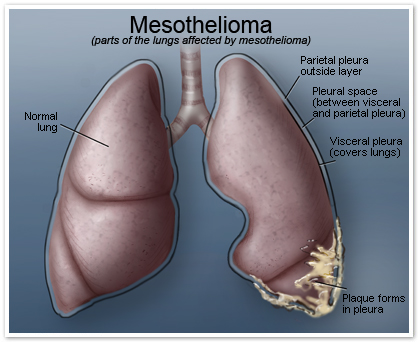
Mesothelioma is an aggressive cancer affecting the membrane lining of the lungs and abdomen.

Malignant mesothelioma is the most serious of all asbestos-related diseases. Although uncommon, mesothelioma cancer is no longer considered rare. The primary cause and risk factor for mesothelioma is exposure to asbestos.

Making a correct mesothelioma diagnosis is particularly difficult for doctors because the disease often presents with symptoms that mimic other common ailments. There is no known cure for mesothelioma, but treatments such as surgery and chemotherapy have helped to improve the typical mesothelioma prognosis.

Pleural mesothelioma (affecting the lung’s protective lining in the chest cavity) represents about three quarters of all mesothelioma incidence. Peritoneal mesothelioma which affects the abdominal cavity and pericardial mesothelioma, which affects the cardiac cavity comprise the remainder. Testicular mesothelioma is extremely rare and is typically presents with metastases of the peritoneal variety. There are three recognized mesothelioma cell-types. Between 50 and 70% of all mesotheliomas are of the epithelial variety. While prognosis is generally poor, these are considered less aggressive than sarcomatoid mesothelioma and biphasic mesothelioma, which comprise the remainder of diagnoses.
Mesothelioma Cancer


The cavities within the body encompassing the chest, abdomen, and heart are surround by a membrane of cells known as the mesothelium. Mesothelial cells assist in general organ functions. The mesothelium is particularly important to organs which are commonly in motion, such as expansion or contraction of the lungs, stomach, or heart. Lubrication from the mesothelial cells allows free range of motion within the body. The mesothelium of the chest, abdomen, and cardiac cavity are called the pleura, the peritoneum, and the pericardium, respectively. Each of these groupings of mesothelial cells are extremely critical to the functions of the body structures which they encompass.

Malignancies (cancerous tumors) occurring within the mesothelial membranes are known as malignant mesothelioma, or simply mesothelioma. Benign tumors of the mesothelium are known to occur, but are much rarer than the more common mesothelioma cancer.

While tumors of the mesothelium were first recognized in the late 18th century, it was not until the middle of the 20th century that this particular cancer was studied and examined with more detail. It was at this time where suspicions of the cancer’s causal relationship with asbestos exposure became more substantiated. A joint study through the Department of Thoracic Surgery at the University of the Witswaterand/Johannesburg General Hospital in South Africa provided the most compelling evidence of the nexus between asbestos exposure and the development of pleural mesothelioma.

Incidence of mesothelioma is still quite rare, with only 2,500-3000 diagnoses in the United States each year. There was a spike in reported diagnoses between 1970 and 1984, which has been attributed to the latency period between diagnosis and the height of industrial exposures- which occurred roughly 40-60 years prior to this time. Exposure was common in nearly all industries but was particularly common in the WWII-era military industrial cycle, including Navy Shipyards.

Although this cancer is much more common in men over the age of 60 (largely attributed to the industrial exposures within male-dominated industries), mesothelioma in women and children has been described as well. Mesothelioma causes for diagnosis in women and children are mainly attributed to secondary exposure to asbestos, as it was not uncommon for men to bring asbestos back into the home on their body or clothing if proper cleaning facilities were not available on site.

Mesothelioma is diagnosed through a comprehensive combination of biopsy and imaging scans.

Mesothelioma can be a difficult malignancy to diagnose because the symptoms and pathology of the disease closely resemble other respiratory conditions. For this reason, misdiagnosis is not uncommon in mesothelioma patients. Symptoms of mesothelioma include chest pain, chronic cough, effusions of the chest and abdomen, and the presence of blood in lung fluid.

Diagnostic surgeries, including a biopsy, will typically be required to determine the type of malignant cells that are present in the body. Typically a body imaging scan, including a magnetic resonance image (MRI) or computer topography (CT scan) will be required to determine the extent and location of the disease.

Mesothelioma patients are generally referred by their personal physicians to one of the many renowned mesothelioma doctors in the United States. These oncologists are well versed in the disease behavior and pathology and are the most familiar with cutting-edge mesothelioma treatment options. Dr. David Sugarbaker of the Brigham and Women's Hospital, an extension of Harvard University and the Dana Farber Cancer Institute in Boston, MA, is at the forefront of mesothelioma treatment through the International Mesothelioma Program.

While mesothelioma is typically advanced at diagnosis, treatment options are available.

Mesothelioma, while certainly an aggressive disease, is a treatable malignancy. While there is no cure for mesothelioma, treatment options including surgery, chemotherapy, and radiation therapy are available for many patients. While a combination of Alimta® and Cisplatin is currently the only FDA approved chemotherapy regimen, several clinical trials are currently in progress utilizing other drugs including Gemcitabine and Onconase, with many showing dramatically improved results in certain cancer patients.

Radiation therapy is also utilized, but typically in conjunction with other treatment methods like surgery and chemotherapy. Surgical resection of mesothelioma is possible in early-stage-diagnosed patients. Aggressive surgeries such as extrapleural pneumonectomy can extend survival rates far beyond previously-thought timeframes. Diagnostic and palliative surgeries such as pleurocentesis and pleurodesis are also common in patients of malignant mesothelioma cancer.

Alternative therapies have also been used effectively by many mesothelioma patients to assist in managing symptoms of the disease and conventional treatments. These treatments are mainly preferential but can be extremely valuable to many patients.

Mesothelioma is caused by exposure to asbestos.

Mesothelioma is only caused by exposure to asbestos, though cases have been documented in children or other individuals with no asbestos history. Asbestos is a microscopic and naturally-occuring mineral that lodges in the pleural lining of the lungs and the peritoneal lining of the abdominal cavity. In most cases, several years will pass (up to 60) before mesothelioma develops in those who had been exposed to asbestos.

In many cases, those diagnosed with mesothelioma who are known to have been exposed to asbestos may be eligible for financial compensation from asbestos manufacturers for their illness. Those who have been diagnosed with mesothelioma and were exposed to asbestos should fill out the brief form on this page. We'll rush you a complimentary mesothelioma and asbestos exposure information kit detailing new mesothelioma treatments, active clinical trials, top doctors, as well as how to obtain compensation for asbestos-related health conditions like mesothelioma.

10 Fruits and Vegetables High In Antioxidan

Antioxidants are used by the body to fight cell damaging free radicals. Research continues to reveal more and more functions of antioxidants in maintaining health. The following ten fruits and vegetables are especially high in antioxidants.

Blueberries
The USDA ranked blueberries highest in antioxidants out of 40 other common fruits and vegetables. Some of the antioxidants they contain are anthocyanins, phenolic, ellagic acid, vitamin C, and vitamin E.

Kale
Kale is vey high in beta-carotene, lutein, selenium, vitamin A, vitamin C, and vitamin E.

Sweet Potatoes
Sweet potatoes are very high in beta-carotene, selenium, anthocyanins, vitamin A, vitamin C, and vitamin E.

Romaine Lettuce
Romaine lettuce is very high in beta-carotene, lutein, selenium, vitamin A, vitamin E, and vitamin C.

Shiitake Mushrooms

Shiitake mushrooms are very high in selenium and vitamin C.

Carrots
Carrots contain beta-carotene, selenium, lutein, vitamin A, vitamin C, and vitamin E.

Canteloupe
Canteloupe contains beta-carotene, selenium and vitamin E, vitamin A and vitamin C.

Bell Peppers
Bell peppers are high in beta carotene, flavenoids, selenium, cysteine, lutein and vitamins A and C.

Tomatoes
Tomatoes are high in beta-carotene, selenium, lycopene, lutein, and vitamin E, vitamin C, and vitamin A.

Olives
Olives are high in beta-carotene, selenium, vitamin A, vitamin C, and vitamin E.